THE BATTLE OF ARRAS – Music by Laura Rossi
World Premiere at Teatro Verdi, Pordenone, October 8th 2025
Le Giornate del Cinema Muto I Pordenone Silent Film Festival
Performed by Orchestra da Camera di Pordenone & Coro del Friuli Venezia Giulia
Conducted by Andrej Goričar
1917 IWM Film by Malins, McDowell & Raymond. Duration: 76’35”
Scoring ‘Battle of Arras’ by Laura Rossi
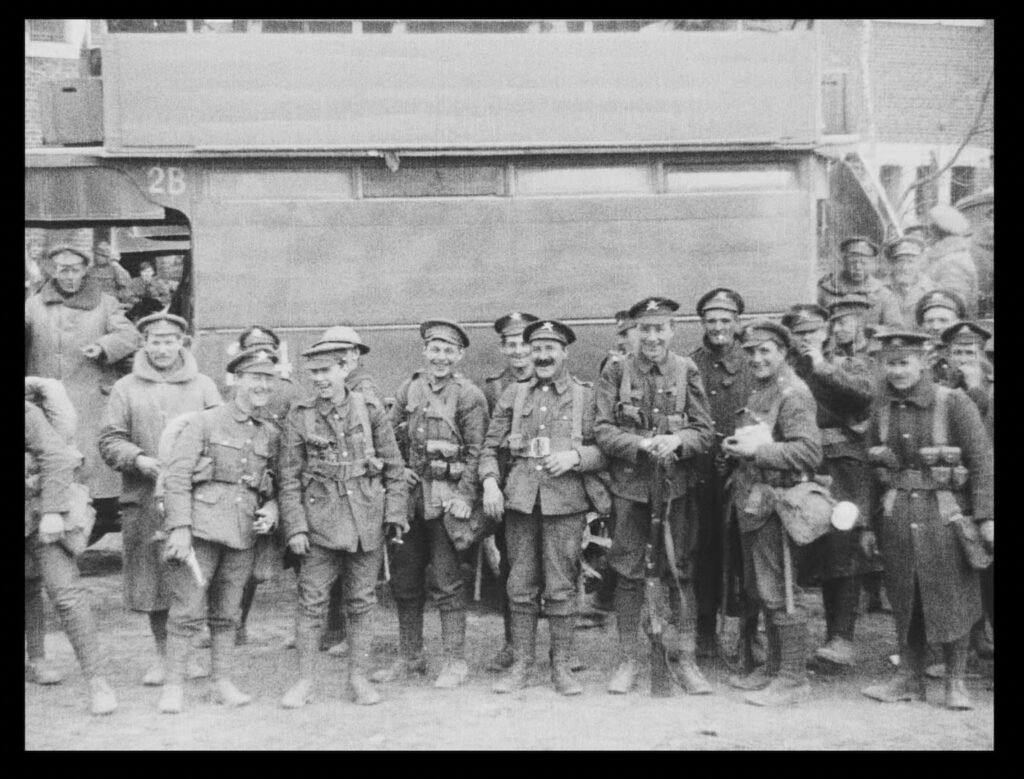
THE BATTLE OF ARRAS was filmed April 1917 by, Malins, McDowell & Raymond and released in June 1917. Having previously scored IWM films Battle of the Somme & Ancre, it’s been an honour to complete the trilogy of scoring these important historical films.
I scored The Somme for full Symphony Orchestra, Ancre for chamber orchestra and it seemed fitting for this film to score it for Choir & Chamber Ensemble (as this film has more footage of local people, more battalions and more of the aftermath, compared to the other films).
RESEARCH
Having spent months working on Somme & Ancre and researching these films, as well as visiting the Somme Battlefields twice, I discovered when working on the Somme, my Great, great Uncle Fred (who I knew – he died when I was 10) was a stretcher bearer and may well be in these films. I have his diaries and retraced his footsteps across the battlefields. This close personal connection to the film and the battle and reading his diaries helped give me a deeper understanding of what it must have been like to be there and helped me to write it from the soldiers’ perspective.
Here’s an extract from my Uncle’s diary: The opening of the Arras film shows the destruction near Péronne caused by the German retreat. My Uncle writes:
“Entered Péronne, German’s in Full retreat. Streets all wrecked and trees thrown all about. Very busy”
A page later he writes:
“Up line for Big Push. Much work. Soaked through. Working 36 hrs in wet things. No dry place to sit anywhere. Noshelter. Heavy/Fritz shelling. Ten Casualties in Ambulance to- date. Awful conditions. Never felt more fed up. Mud knee deep.”
Musical Approach
This film has some very moving scenes as it shows the aftermath of war and so I felt it would work well with music that enhanced this. So my main aim with the score was to help provide a structure and help make the film more moving and engaging to watch.
I decided it would work well as a choral piece using poetry and text (in English, French and German) mainly written by the Soldiers’ who were there but a couple of poems I set are written by people back home. I also arranged a few songs as part of the score.
I also listened to IWM recordings of soldiers talking about their experiences of war, and found this incredibly moving tape of a soldier “Neyland” who was at Arras talking about the songs they sang and he breaks into song singing “When this wicked war is over” so I decided to use this for the end credits and wrote an orchestral accompaniment for it – it’s an incredibly powerful and poignant ending to the film.
MORE INFO about the Premiere in Italy